Medial Branch Block vs. Radiofrequency Ablation
Medial branch blocks help test whether targeted spinal nerves contribute to facet-related pain, while radiofrequency ablation treats confirmed nerve pain for longer-lasting relief. Premier Injury Specialists evaluates your symptoms, exam findings, and block response before discussing whether ablation fits.
Request an EstimateWhat’s the Difference Between a Medial Branch Block and Radiofrequency Ablation?
Medial branch blocks test whether specific nerves carry pain, while radiofrequency ablation uses heat to reduce pain signals from confirmed target nerves.
A medial branch block is a diagnostic injection near selected medial branch nerves. These nerves carry signals from facet joints, which can contribute to neck pain, back pain, or other spinal pain.
Radiofrequency ablation uses radiofrequency energy to affect selected pain-carrying nerves. It can treat a supported pain pattern, but it doesn't repair every cause of facet-mediated pain.
Medial Branch Block vs. Radiofrequency Ablation at a Glance
The better option depends on whether the goal is confirming a pain source or treating a confirmed nerve pain pattern.
Both procedures require patient evaluation, treatment planning, and attention to possible risks. Cost drivers include the evaluation, procedure planning, imaging needs, facility setting, coverage, and follow-up care.
| Factor | Medial Branch Block | Radiofrequency Ablation |
|---|---|---|
| Primary purpose | Tests whether targeted medial branch nerves contribute to pain | Reduces pain signals from selected medial branch nerves |
| Cost | Depends on evaluation, injection planning, imaging, and coverage | May involve different planning, facility, imaging, and follow-up costs |
| Timeline | Used during evaluation before a treatment decision | Usually considered after the response supports the targeted pain source |
| Maintenance | May be repeated or followed by another treatment decision | May require future reassessment if pain returns |
| Best for | Patients who need diagnostic information about facet-related pain | Patients whose evaluation supports treatment of targeted nerve pain |
How Does a Medial Branch Block Help Guide Treatment?
A medial branch block injects medication near selected medial branch nerves to see whether reducing those signals changes the patient's pain.
The local anesthetic can create a focused diagnostic response. We compare that response with the patient's pain pattern, physical examination, and other findings.
A block isn't proof that every back or neck pain source comes from the facet joints. Our team uses the result as one part of treatment planning. Learn more about medial branch block treatment.
When Is Radiofrequency Ablation Considered?
Radiofrequency ablation is considered when the evaluation and block response support the medial branch nerves as a likely pain source.
The procedure uses radiofrequency energy to target selected nerves that carry pain signals. It doesn't correct every spinal structure or every cause of spinal pain.
We consider symptoms, examination findings, prior treatment response, medical history, and treatment goals. These factors help us decide whether radiofrequency treatment fits the patient's needs.
What Are the Advantages of a Medial Branch Block?
A medial branch block can provide focused information about whether targeted nerves contribute to the patient's pain.
Best for: Patients who need to clarify a suspected facet-related pain source.
What Are the Advantages of Radiofrequency Ablation?
Radiofrequency ablation can offer a treatment option when targeted nerve pain is supported by the clinical evaluation.
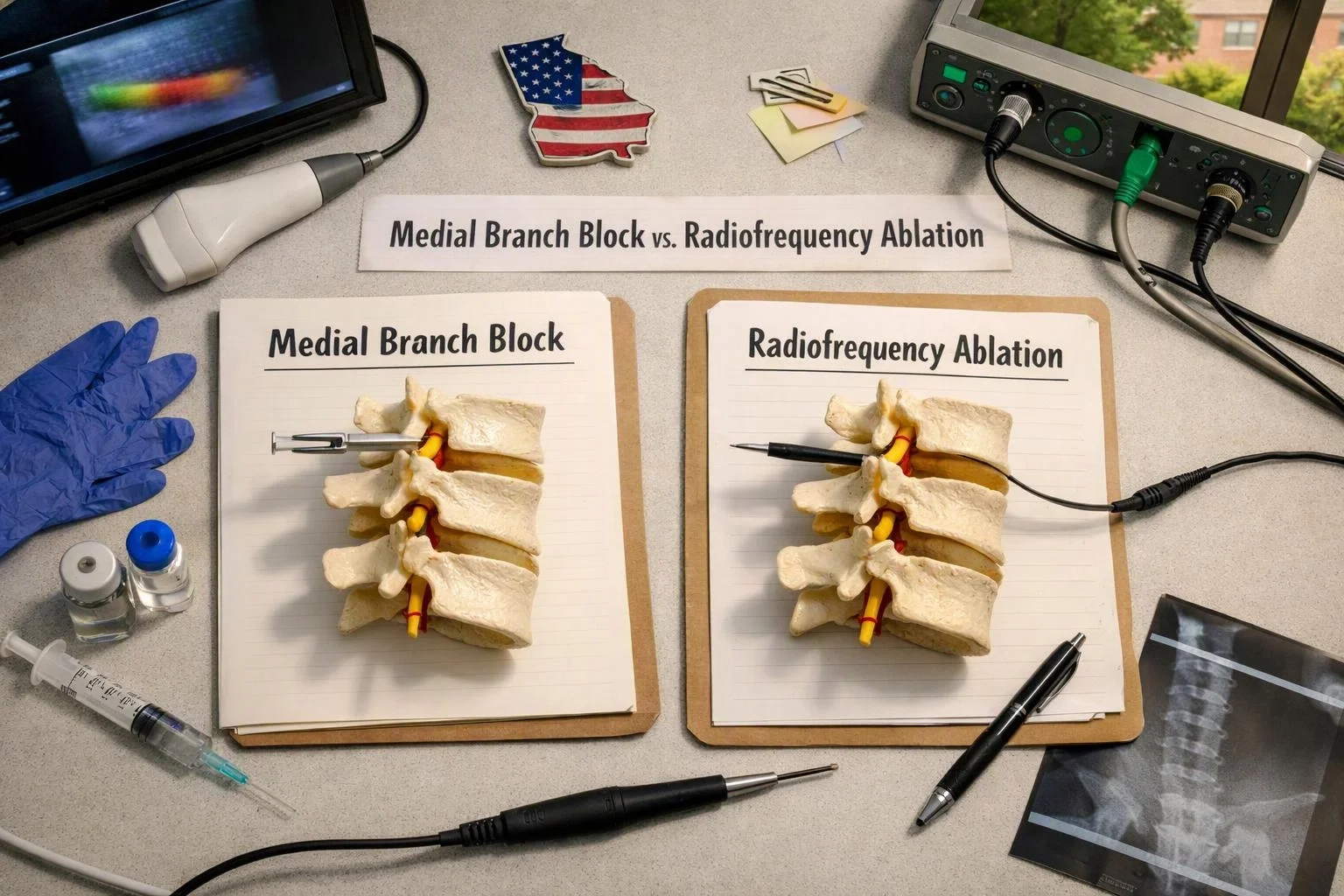
Best for: Patients whose evaluation supports treating targeted medial branch nerve pain.
Does a Medial Branch Block Come Before Radiofrequency Ablation?
Often, yes, because a medial branch block can help determine whether radiofrequency ablation targets a likely pain source.
The sequence depends on symptoms, examination findings, prior care, and clinical evidence. A block isn't an automatic requirement for every patient.
We discuss the purpose of diagnostic testing before recommending the next step. The goal is to connect the treatment with the most supported pain source.
What Happens If a Medial Branch Block Doesn’t Help?
If a medial branch block doesn't improve the relevant pain, we reassess whether the targeted nerves are the main pain source before discussing ablation.
Our team may review the pain location, symptoms, examination findings, and treatment response. We may also consider other spinal or non-spinal causes.
A limited response doesn't automatically make radiofrequency ablation appropriate. Treatment planning must match the complete patient evaluation.
How We Evaluate Patients Before Radiofrequency Ablation
We evaluate the pain pattern, examination findings, prior treatment response, and medical history before discussing radiofrequency ablation.
What Should You Ask Before Scheduling Radiofrequency Ablation?
Before scheduling radiofrequency ablation, ask what evidence supports the target, what outcome is realistic, and what follow-up the plan includes.
Ask which pain source the procedure targets and what role any prior diagnostic block played. Ask about possible risks, alternatives, recovery guidance, and follow-up care.
Cost drivers may include the evaluation, procedure planning, imaging, facility setting, coverage, and follow-up. We explain what the consultation and planned care include so you can request an exact quote.
Which Option Fits Your Pain Evaluation?
The right option depends on whether your evaluation needs diagnostic information or supports treatment of targeted medial branch nerve pain.
A medial branch block may fit when the main question is whether facet-mediated pain contributes to your symptoms. Radiofrequency ablation may fit when the evaluation supports treating that confirmed pain pattern.
We build an individualized treatment plan around your symptoms, physical examination, medical history, treatment goals, and response to prior care.
Premier Injury Specialists can discuss the possible benefits, procedure risks, treatment alternatives, and follow-up care during a consultation.
Questions About Medial Branch Blocks and Radiofrequency Ablation
Can radiofrequency ablation be considered without a medial branch block?
Yes, radiofrequency ablation can be considered without a medial branch block in selected cases, depending on the symptoms, examination, prior care, and clinical findings. Premier Injury Specialists reviews the full evaluation before discussing whether ablation fits.
What conditions can make radiofrequency ablation unsuitable?
Radiofrequency ablation may be unsuitable when the pain source is unclear, the pain pattern does not match the targeted nerves, the diagnostic response is limited, or medical factors raise concern. We review alternatives when ablation does not match the patient's needs.
Can radiofrequency ablation treat both neck and back pain?
Yes, radiofrequency ablation can be considered for selected neck or back pain patterns when the evaluation supports targeted medial branch nerve pain. The treatment plan depends on the involved region and the patient's clinical findings.
What should I bring to a consultation about medial branch block or radiofrequency ablation?
Bring a list of current medicines, relevant medical history, imaging reports, prior procedure details, and notes about your pain pattern. These details help us review treatment goals, prior response, possible risks, and alternatives.
Related Resources
Imaging Guidance for Pain Procedures: Fluoroscopy and Ultrasound
Brand vs BrandHow to Choose a Pain Management Physician in Stockbridge
Brand vs BrandRadiofrequency Ablation Providers Worth Comparing in Stockbridge (2026)
Brand vs BrandMedial Branch Blocks Providers Worth Comparing in Stockbridge (2026)